

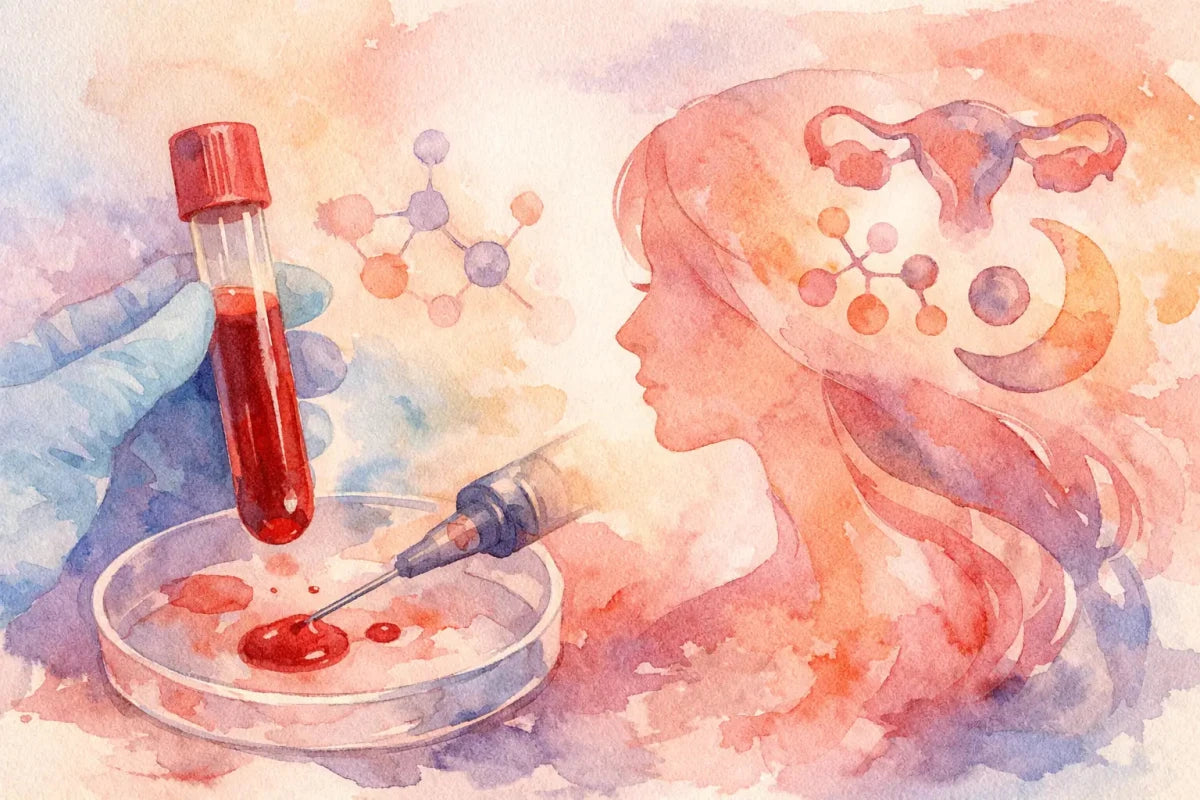
Sentirse "mal" sin una razón clara es frustrante. Si estás lidiando con cambios de peso persistentes, bajo estado de ánimo, fatiga, periodos irregulares, libido reducida, acné, adelgazamiento del cabello o mala calidad del sueño, un análisis de sangre para detectar desequilibrios hormonales puede ser un primer paso práctico para averiguar qué está sucediendo.
Las hormonas afectan mucho más que la reproducción. Ayudan a regular el apetito, el metabolismo, la respuesta al estrés, la energía, la piel, el sueño y la función sexual. Por eso los síntomas pueden superponerse con el estrés diario, el sueño deficiente, el envejecimiento, los efectos secundarios de los medicamentos o las afecciones de salud subyacentes. Las pruebas ayudan a aclarar el panorama, pero solo funcionan bien cuando se verifican las hormonas correctas en el momento adecuado.
¿Qué es un análisis de sangre para detectar un desequilibrio hormonal?
Un análisis de sangre para detectar un desequilibrio hormonal mide el nivel de hormonas específicas en tu torrente sanguíneo. En lugar de dar un sí o un no a la pregunta "¿Tengo un problema hormonal?", busca patrones que puedan indicar problemas como disfunción tiroidea, testosterona baja, menopausia, perimenopausia, síndrome de ovario poliquístico, prolactina elevada o estrés suprarrenal.
Esto es importante porque los síntomas hormonales rara vez son únicos. El cansancio podría estar relacionado con la función tiroidea, los niveles de hierro, el sueño deficiente, la testosterona baja, el estrés, la depresión o un déficit calórico. El aumento de peso podría estar relacionado con la menopausia, la resistencia a la insulina, la medicación, factores del estilo de vida o una tiroides hipoactiva. Un análisis de sangre ayuda a separar las conjeturas de la evidencia.
También ayuda a los médicos a decidir qué debe suceder a continuación. En algunos casos, los resultados anormales apoyan el tratamiento. En otros, muestran que las hormonas no son el problema principal, lo que puede ahorrar tiempo y ayudarte a concentrarte en la causa correcta más pronto.
¿Qué hormonas se suelen revisar?
El panel depende de tus síntomas, sexo, edad e historial médico. No existe una única prueba que cubra todos los posibles problemas hormonales.
Hormonas tiroideas
Las pruebas de tiroides a menudo incluyen TSH y, a veces, T4 libre y T3 libre. Estos resultados pueden ayudar a identificar una tiroides hipoactiva o hiperactiva, las cuales pueden afectar el peso, el estado de ánimo, la energía y la sensibilidad a la temperatura.
Hormonas reproductivas femeninas
Para las mujeres, las pruebas pueden incluir estradiol, progesterona, hormona foliculoestimulante y hormona luteinizante. Estas suelen ser útiles al investigar periodos irregulares, problemas de fertilidad, síntomas de perimenopausia o problemas de ovulación sospechosos.
Testosterona y marcadores relacionados
La testosterona es relevante tanto para hombres como para mujeres, aunque el contexto es diferente. En los hombres, la testosterona baja puede contribuir a la libido baja, dificultades eréctiles, reducción de la masa muscular, cansancio y bajo estado de ánimo. En las mujeres, los niveles más altos de andrógenos pueden ser parte del cuadro en el acné, el crecimiento excesivo de vello o el SOP sospechoso. También se pueden incluir la globulina fijadora de hormonas sexuales y el índice de andrógenos libres.
Prolactina y cortisol
La prolactina puede afectar los ciclos menstruales, la libido y la fertilidad. El cortisol es más complejo. A menudo se describe como la hormona del estrés, pero un solo resultado de sangre no siempre cuenta la historia completa porque el cortisol cambia a lo largo del día y se ve afectado por enfermedades, el sueño y el estrés.
¿Cuándo deberías considerar hacerte la prueba?
Las pruebas tienen sentido cuando los síntomas son persistentes, inexplicables o comienzan a afectar la vida diaria. Esto incluye fatiga continua, cambio de peso inexplicable, periodos alterados, libido reducida, disfunción eréctil, sofocos, sudores nocturnos, pérdida de cabello, acné, cambios en los senos o dificultad para dormir.
También puede ser útil si ya estás intentando mejorar tu salud pero no estás viendo los resultados esperados. Por ejemplo, si estás comiendo bien, haciendo ejercicio regularmente y aún luchas con el peso o la energía, un médico podría querer verificar si la función tiroidea, las hormonas sexuales u otros marcadores podrían estar contribuyendo.
Dicho esto, el momento es importante. Un análisis de sangre es menos útil si los síntomas acaban de comenzar, si estás gravemente enfermo, o si es probable que el resultado se distorsione por la medicación actual, el embarazo o el punto en el que te encuentras en tu ciclo menstrual.
Por qué el momento cambia el resultado
Las hormonas no permanecen en un nivel constante. Algunas varían según la hora del día y otras cambian a lo largo del mes.
Para la testosterona, generalmente se prefieren las muestras de la mañana, especialmente en hombres, porque los niveles tienden a ser más altos temprano en el día. Para las hormonas reproductivas femeninas, el mejor día para realizar la prueba depende de lo que esté evaluando tu médico. La progesterona a menudo se mide en un punto específico después de la ovulación en lugar de en una fecha aleatoria. La FSH y la LH también pueden significar cosas diferentes según el momento del ciclo.
Esta es una de las razones por las que las pruebas genéricas pueden ser engañosas. Un resultado normal tomado en el momento equivocado puede no ser realmente tranquilizador, mientras que un resultado limítrofe puede parecer más significativo de lo que es.
Lo que los resultados pueden decirte y lo que no
Un análisis de sangre útil puede mostrar si tus niveles hormonales se encuentran dentro de los rangos esperados y si esos niveles se ajustan a tus síntomas. Puede identificar un problema claro, como hipotiroidismo o testosterona muy baja. También puede sugerir un patrón que necesite seguimiento, como posible menopausia, SOP o prolactina elevada.
Pero los análisis de sangre tienen límites. Un resultado normal no siempre significa que no haya nada malo. Algunas personas tienen síntomas a pesar de que los resultados se encuentran dentro del rango de referencia. De igual manera, un resultado ligeramente anormal no siempre explica todo. Los niveles hormonales deben interpretarse junto con los síntomas, el historial médico, el uso de medicamentos y, a veces, la repetición de las pruebas.
Los rangos de referencia también tienen límites. Muestran lo que es estadísticamente común en una población, no necesariamente lo que es óptimo para cada individuo. Por eso es importante la revisión por parte de un clínico.
Razones comunes por las que se solicitan análisis de sangre hormonales
Cambios de peso y problemas metabólicos
Si la ganancia de peso parece desproporcionada a tu rutina, los médicos pueden examinar los marcadores tiroideos y, a veces, las hormonas sexuales, especialmente alrededor de la perimenopausia o la menopausia. Las hormonas pueden influir en el apetito, la composición corporal y la sensibilidad a la insulina, pero son solo una parte del panorama.
Síntomas de menopausia y perimenopausia
Los sofocos, la niebla mental, los sudores nocturnos, el sueño deficiente y los cambios en el ciclo son razones comunes para realizar pruebas. En mujeres mayores de 45 años, el diagnóstico de perimenopausia a menudo se basa más en los síntomas que en los análisis de sangre, porque los niveles hormonales fluctúan significativamente. Las pruebas aún pueden ser útiles en casos seleccionados.
Libido baja, fatiga y síntomas de salud sexual
En los hombres, la testosterona baja puede explorarse si hay libido baja persistente, disfunción eréctil o energía reducida. En las mujeres, los cambios en la libido pueden estar relacionados con cambios en los estrógenos, la testosterona, el estrés, factores de relación, medicamentos o el sueño.
Caída del cabello, acné e irregularidad del ciclo
Estos síntomas pueden llevar a la verificación de andrógenos, función tiroidea y, a veces, prolactina. El SOP es una posible causa, pero no es la única.
Pruebas en casa vs. pruebas en la clínica
Para muchos adultos, las pruebas de sangre en casa son la opción más práctica. Ofrecen privacidad, rapidez y conveniencia, especialmente si estás manejando el trabajo, el cuidado de los niños o una agenda apretada. También pueden facilitar el inicio de la investigación de los síntomas sin esperar una cita presencial.
La contrapartida es que la conveniencia no debe ir en detrimento de la interpretación. Una prueba por sí sola es solo una parte del proceso. El valor real proviene de elegir el panel correcto y de que los resultados sean revisados por un clínico calificado que pueda explicar qué necesita acción y qué no.
Aquí es donde la atención digital regulada puede funcionar bien. Proveedores como Rightangled combinan las pruebas en casa con la supervisión clínica, lo que ayuda a mantener el proceso eficiente sin reducirlo a un ejercicio de números.
Cómo prepararse para un análisis de sangre hormonal
La preparación depende de las hormonas que se vayan a analizar. Algunas pruebas se realizan mejor por la mañana. Otras pueden necesitar programarse según tu ciclo menstrual. También se te puede preguntar sobre medicamentos, suplementos, anticonceptivos o terapia de reemplazo hormonal, ya que estos pueden afectar los resultados.
Si no estás seguro de si debes suspender algo antes de la prueba, no adivines. Suspender un tratamiento prescrito sin asesoramiento puede empeorar los síntomas y también distorsionar el cuadro clínico.
También ayuda a anotar tus síntomas antes de la prueba. Incluye cuándo comenzaron, si son constantes o cíclicos, y cualquier cosa que los mejore o empeore. Ese contexto a menudo importa tanto como los números.
¿Qué sucede después de la prueba?
Una vez que se obtienen los resultados, el siguiente paso depende de lo que muestren. Es posible que te tranquilices al saber que no hay un problema hormonal importante evidente. Es posible que necesites repetir las pruebas para confirmar un patrón. O es posible que se te aconseje considerar un tratamiento, un seguimiento o una derivación para una evaluación adicional.
La clave es no autodiagnosticarse a partir de un único resultado de forma aislada. Los foros de discusión en línea y los verificadores de síntomas pueden ser útiles para reconocer patrones, pero son deficientes para juzgar el contexto. El mismo nivel de testosterona puede ser significativo en una persona e irrelevante en otra.
Si tus síntomas están afectando tu calidad de vida, esperar y dudar no suele ayudar a nadie. Un análisis de sangre bien elegido puede darte un punto de partida más claro, ya sea que la respuesta sea hormonal o no. Y esa claridad es a menudo el primer paso real para sentirse mejor.


Compartir:
Control de peso después de dietas fallidas
¿Puede Ozempic causar depresión? Esto es lo que dice la investigación.