
Medically reviewed by: Dr Abdullah
Reading time: 6 minutes · Guidance verified: September 2026
Ask which GLP-1 is best for weight loss and most answers line up figures from separate trials, which is the one comparison that does not hold. Only one study has put two of these medicines directly against each other. Here is what it found, what the rest of the evidence shows, and why the biggest number is not automatically the right choice for you.
Which GLP-1 is best for weight loss on the direct evidence?
SURMOUNT-5 randomised 751 adults with obesity, or overweight with a weight-related condition and no diabetes, to either tirzepatide or semaglutide by injection, each titrated to the highest tolerated maintenance dose, for 72 weeks.
At week 72, mean weight reduction was 20.2% with tirzepatide against 13.7% with semaglutide. In absolute terms that was roughly 22.8 kg against 15.0 kg. The gap widened at the higher thresholds: 87.7% of the tirzepatide group lost at least 10% of body weight, against 66.7%, and 71.7% lost at least 15%, against 45.0%.
This is the single most useful piece of evidence available, because both arms ran in the same population, over the same period, using the same definitions. On that basis, tirzepatide produced the larger average reduction.

Why the usual comparison tables mislead
Almost every article answering which GLP-1 is best for weight loss builds a table from separate trials. That approach breaks for two reasons.
First, populations and durations differ. A 56 week trial in one group is not comparable to a 72 week trial in another.
Second, and more often missed, trials report two different figures. The treatment-regimen or treatment-policy estimand counts everyone regardless of whether they stayed on treatment. The efficacy estimand counts only those who adhered. The second number is always flattering, and articles frequently quote it for one medicine and the first for another. The table below uses the conservative figure throughout.
GLP-1 options licensed for weight management in the UK
Five are relevant when deciding which GLP-1 is best for weight loss in practice. All five require a prescription and a clinical assessment.
|
Medicine |
Active ingredient |
Form |
Average reduction |
|
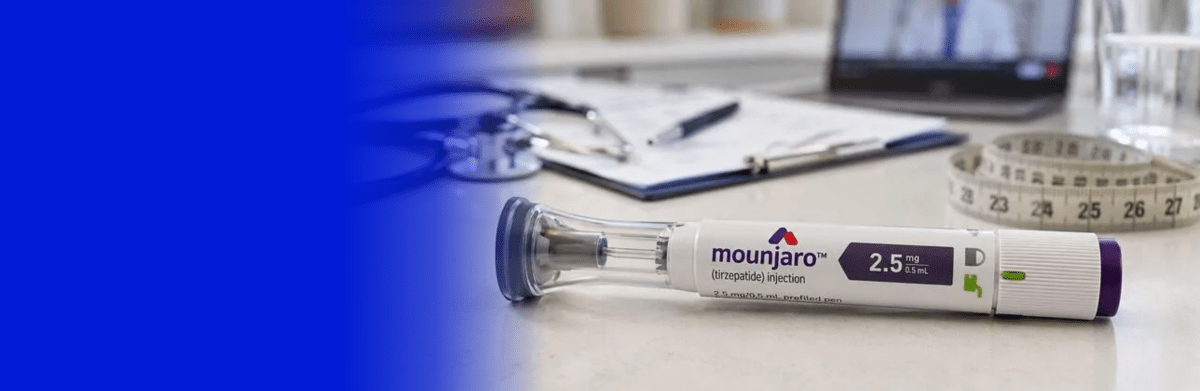
Mounjaro |
Tirzepatide |
Weekly injection |
20.2% at 72 weeks |
|
Wegovy injection |
Semaglutide 2.4 mg |
Weekly injection |
13.7% at 72 weeks |
|
Wegovy tablets |
Semaglutide 25 mg |
Daily tablet |
13.6% at 64 weeks |
|
Foundayo |
Orforglipron |
Daily tablet |
11.2% at 72 weeks |
|
Liraglutide |
Liraglutide 3 mg |
Daily injection |
Around 8% at 56 weeks |
Mounjaro is the only dual agonist on the list. It activates both GLP-1 and GIP receptors, which is the working explanation for the larger average reduction.
The Wegovy injection is a single-receptor GLP-1 agonist with the longest real-world track record and established cardiovascular outcome data behind it.
Wegovy tablets deliver the same active ingredient orally. The trade is a strict routine: fasted first thing, a sip of water only, and nothing else for 30 minutes.
Foundayo is a small-molecule, non-peptide GLP-1 agonist. Its average reduction is the lowest of the three newest options, but it is the only tablet with no fasting or food restrictions at all.
 Where Ozempic fits, and why it is not on that list
Ozempic contains semaglutide, the same active ingredient as Wegovy, and it is a GLP-1 receptor agonist. It is not, however, a weight loss medicine in the UK.
MHRA guidance sets this out plainly. Ozempic and Rybelsus are licensed to treat diabetes, not for weight loss or weight management. Wegovy is licensed for weight management but not for diabetes. Mounjaro is licensed for both. The MHRA has also stated that it has not assessed the safety or effectiveness of these medicines used outside their licensed indications.
Rightangled does not supply Ozempic for weight loss, because it is not licensed for that use here. Anyone offering it for weight management is working outside the UK licence. If you are based outside the UK, treatment is provided through Medetone in Europe and Medetone US in the United States, where the licensed options differ by country and are assessed against local regulations.
Why the biggest number is not always the answer
Trial averages describe groups. You are an individual, and several factors matter more than a percentage point.
Trial averages answer which GLP-1 is best for weight loss across a population, not for you.
Tolerability. Gastrointestinal effects are the most common reason people stop. A medicine you tolerate at the full dose will outperform a theoretically stronger one you abandon at week six.
Needles. For some people injection is a genuine barrier. Two licensed tablets now exist, which did not last year.
Your morning routine. If you take levothyroxine, work night shifts, or travel across time zones, the fasted window required by oral semaglutide may be unworkable. Foundayo has no such requirement.
Type 2 diabetes. If you have it, only some of these carry a licence covering both conditions, which narrows the choice considerably.
Adherence over time. Every one of these medicines works only while taken. Trials consistently show substantial weight regain after stopping, so the realistic question is which treatment you can sustain for years.
So which GLP-1 is best for weight loss?
On the head-to-head evidence, tirzepatide produced the largest average reduction. That is the closest thing to a definitive answer the research currently supports.
But asking which GLP 1 is best for weight loss in the abstract is the wrong framing. The better question is which licensed treatment fits your medical history, your tolerance for side effects, your daily routine and your ability to keep going. A prescriber weighs all of that. A comparison table cannot.
Eligibility and UK guidance
Before choosing, eligibility decides the shortlist.
The licensed criteria are consistent across these treatments: adults with a BMI of 30 or above, or a BMI between 27 and 30 with at least one weight-related condition such as type 2 diabetes, high blood pressure, high cholesterol or obstructive sleep apnoea. All are licensed as an adjunct to a reduced-calorie diet and increased physical activity.
NICE recommends semaglutide under TA875 and tirzepatide under TA1026, both with a review point at six months. The MHRA advises obtaining these medicines only from a registered pharmacy against a valid prescription, and warns that GLP-1 medicines are not intended for cosmetic weight loss.
You can compare the full range on our weight management treatments page, or start a clinical assessment to find out which options you are eligible for.
Frequently asked questions
Which GLP-1 is best for weight loss if I cannot use needles?
Two licensed tablets are available. One requires a fasted morning routine, the other does not.
Is a dual agonist always better than a GLP-1 alone?
On average in the head-to-head trial, yes. For any individual, tolerability and adherence can reverse that.
Can I switch if my current treatment is not working?
Often, yes, but switching must be planned by a prescriber. Doses are not interchangeable between medicines.
“Patients arrive having decided on a medicine from a league table. The trial data is real, but the average says nothing about how one person will tolerate a dual agonist, or whether they can hold a fasted window every morning for a year. That is the conversation worth having.”
Dr Abdullah Alhasan, Medical Director at Rightangled
Every weight management consultation at Rightangled is reviewed by GPhC-registered independent prescribers as soon as the consultation is submitted. Treatment is supplied only where it is clinically appropriate, and individual responses vary.
Verify us before you trust us
References
1. MHRA. GLP-1 medicines for weight loss and diabetes: what you need to know. GOV.UK, updated 5 February 2026. MHRA guidance on GLP-1 medicines
2. NICE. Semaglutide for managing overweight and obesity, TA875. NICE technology appraisal TA875
3. NICE. Tirzepatide for managing overweight and obesity, TA1026. NICE technology appraisal TA1026
4. Aronne LJ, et al. Tirzepatide as Compared with Semaglutide for the Treatment of Obesity (SURMOUNT-5). N Engl J Med, 2025. SURMOUNT-5 head-to-head trial
This article is for information only and is not a substitute for individual medical advice. GLP-1 receptor agonists are prescription-only medicines. Suitability, dosing and expected outcomes vary between individuals and must be assessed by a prescriber. Always read the patient information leaflet supplied with your medicine. Last reviewed September 2026.