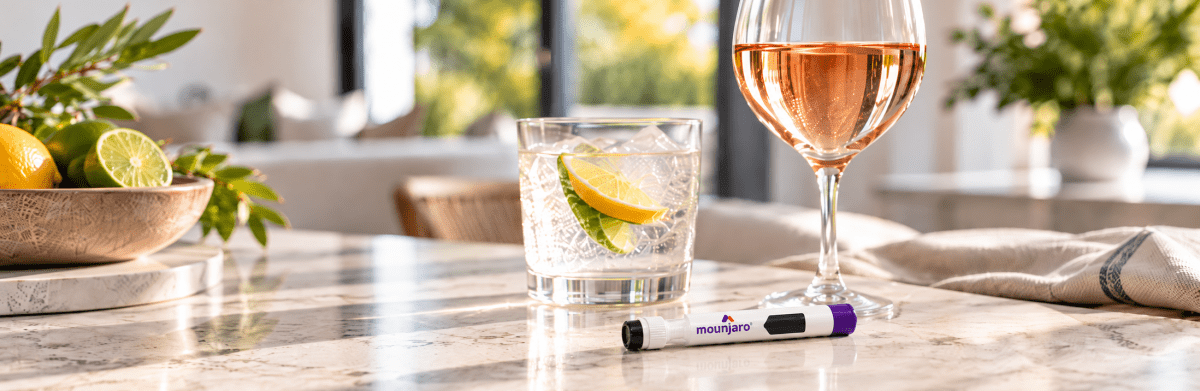
There is no direct pharmacological interaction between Mounjaro and alcohol. Nothing in the medicine reacts with ethanol, and a drink does not stop tirzepatide working.
That is also where most guidance stops, and it is not enough. The risks here are additive rather than interactive, which is a different thing and worth understanding properly. If you want the straight yes or no first, our guide on whether you can drink while taking Mounjaro answers it. This article covers the practical dos and don'ts.
Why Mounjaro and alcohol need care despite no interaction
Tirzepatide slows gastric emptying, lowers blood glucose in a glucose-dependent way, and reduces appetite. Alcohol irritates the stomach lining, interferes with how the liver releases stored glucose, and dehydrates you.
Put those two lists side by side and the overlap is obvious. Neither changes the other chemically. They simply push on the same systems at the same time. That is why the sensible approach is about timing and quantity rather than abstinence or permission. You can read more about how Mounjaro works for the underlying mechanism.

Mounjaro and alcohol: the four risks that are real
1. Stacked gastrointestinal effects. Nausea, vomiting, diarrhoea and abdominal discomfort are the most common side effects of treatment, and alcohol causes the same symptoms independently. Combining them makes a difficult evening considerably more likely, especially during dose escalation.
2. Low blood sugar. This is the one most people underestimate. Tirzepatide alone carries a low intrinsic risk of hypoglycaemia because its effect is glucose-dependent. Alcohol changes that, because it suppresses the liver's ability to release stored glucose, which is your body's normal rescue mechanism. If you also take insulin or a sulfonylurea for type 2 diabetes, this combination becomes a genuine clinical risk rather than a theoretical one.
3. Pancreatitis risk. Acute pancreatitis is a recognised, uncommon risk with GLP-1 medicines. Heavy alcohol use is one of the leading causes of pancreatitis in its own right. The two risks sit on top of each other.
4. Dehydration. Alcohol is a diuretic. If you are also experiencing vomiting or diarrhoea, fluid loss compounds quickly, and dehydration is itself a route to acute kidney injury.
The dos of Mounjaro and alcohol
Do stay inside the UK guideline. The UK Chief Medical Officers advise no more than 14 units a week, spread over three or more days, with several drink-free days. That applies to everyone, and it is a sensible ceiling here rather than a target.
1. Do eat first. Never drink on an empty stomach. Food slows alcohol absorption and helps keep blood glucose stable. A meal with protein is better than a snack. Our guide to eating on Mounjaro covers what that looks like in practice.
2. Do alternate with water. A glass of water between drinks slows the pace and offsets fluid loss.
3. Do leave time after your injection. Side effects are most pronounced in the days following a dose, particularly after an increase. Waiting a few days is more sensible than drinking the same evening.
4. Do tell someone. If you have type 2 diabetes, let whoever you are with know you are on treatment. The early signs of low blood sugar and the effects of alcohol look very similar from the outside.
The don'ts
1. Do not binge. More than six units in a session for women or eight for men is defined as binge drinking. On this treatment it raises every one of the four risks above simultaneously.
Most problems with alcohol and Mounjaro come from these five.
2. Do not drink during the first few weeks. Your body is adjusting, and if you feel unwell you will not know whether to blame the medicine, the alcohol, or both. That uncertainty causes people to stop treatment unnecessarily.

3. Do not drink after a dose increase until you know how you have tolerated the new dose.
4. Do not use alcohol as a reward for progress. It is a common pattern and an unhelpful one, since it ties a goal you are working towards to something that works against it.
5. Do not ignore symptoms. Severe or persistent abdominal pain, repeated vomiting, or signs of dehydration need medical advice promptly. The same applies to the foods that worsen side effects during escalation.
The best alcohol to drink on Mounjaro
No drink is pharmacologically safer than another. If you are choosing, the sensible criteria are lower sugar, lower volume and fewer calories.
A spirit with a sugar-free mixer or soda water, or a small glass of dry wine, carries less sugar than cocktails, liqueurs, cider or full-sugar mixers. Carbonated drinks can worsen bloating when gastric emptying is already slowed, so still options tend to be more comfortable.
Calories matter too, since appetite is reduced and every intake has to count for more. A 175 ml glass of wine is roughly 160 calories and a pint of 5% beer around 220, none of it nutritional. Alcohol-free alternatives avoid the problem, though some are high in sugar, so it is worth checking the label.
Cravings and tolerance
Some people report that their desire to drink falls while on treatment, and research into GLP-1 medicines and alcohol consumption is ongoing. Tirzepatide is not licensed or indicated for alcohol dependence, and should never be taken for that purpose.
Others find alcohol affects them more than it used to. Weight reduction changes body composition and how alcohol distributes, so a familiar amount can feel stronger. If you notice that, treat it as information and adjust what you drink rather than pushing through.
If you are worried about how much you drink, raise it before starting treatment rather than after. It changes the clinical picture and it is a conversation prescribers have routinely.
Frequently asked questions
Does alcohol stop Mounjaro working?
No. It does not reduce the medicine's effect, but the calories and the loosened restraint around food can slow progress.
How long should I wait after injecting?
There is no fixed rule. A few days is sensible, particularly after a dose increase.
Are Mounjaro and alcohol side effects worse together?
Commonly yes, because both cause gastrointestinal symptoms independently.
Can I drink if I have type 2 diabetes?
Discuss it with your prescriber first. The hypoglycaemia risk is materially higher if you also take insulin or a sulfonylurea.
Patients based in Europe are served by Medetone, and those in the United States by Medetone US.
The short version
Mounjaro and alcohol do not interact, but they stack. Stay within 14 units a week, never drink on an empty stomach, leave a few days after each injection, and skip it entirely during your first weeks and after every dose increase. Choose lower sugar and lower volume if you do drink. For the direct answer on whether drinking is permitted at all, see our guide on drinking while taking Mounjaro, and treatment details are on the Mounjaro page.
“The hypoglycaemia point is the one I want patients to take away. On its own the medicine rarely causes it. Add alcohol, which blocks the liver from releasing glucose, and add insulin or a sulfonylurea, and the picture changes completely. That combination deserves a proper conversation.”
Dr Abdullah Alhasan, Medical Director at Rightangled
Tirzepatide carries Black Triangle status in the UK, meaning additional MHRA monitoring. Report suspected side effects through the MHRA Yellow Card scheme. Every weight management consultation at Rightangled is reviewed by GPhC-registered independent prescribers as soon as the consultation is submitted. Compare options on our weight management treatments page or begin a clinical assessment.
Verify us before you trust us
References
1. Department of Health and Social Care. UK Chief Medical Officers' Low Risk Drinking Guidelines. GOV.UK. UK CMO low risk drinking guidelines
2. MHRA. GLP-1 medicines for weight loss and diabetes: what you need to know. GOV.UK. MHRA guidance on GLP-1 medicines
3. NICE. Tirzepatide for managing overweight and obesity, TA1026. NICE technology appraisal TA1026
4. MHRA. Drug Safety Update, GLP-1 receptor agonists. October 2024. MHRA Drug Safety Update on GLP-1 receptor agonists
This article is for information only and is not a substitute for individual medical advice. Tirzepatide is a prescription-only medicine and is not licensed for the treatment of alcohol dependence. If you are concerned about your drinking, speak to your prescriber or GP. Suitability and outcomes vary between individuals. Last reviewed October 2026.